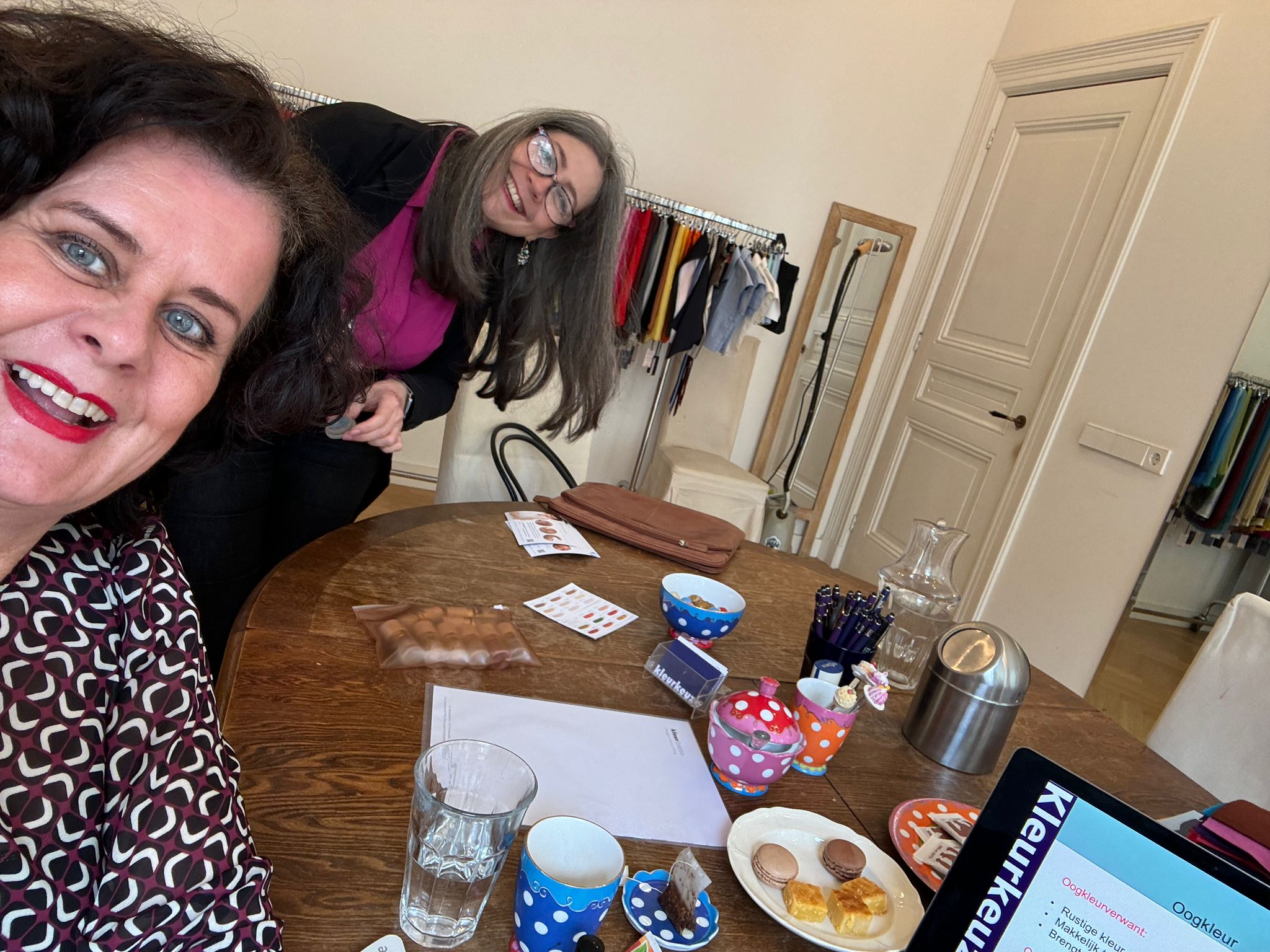
We all know that colour is important for your look. Your hair colour, eye colour is different for everyone, unique even. How you colour yourself with clothes or make-up are aspects that are important for your appearance. Janny Hanegraaf followed a training on colour with Mirjam Bach of Colour Choice image consulting. Every day, Mirjam looks at the client to determine what seasonal type you are and gives appropriate colour advice. She also provides training on colour. I, Lenie van der Zande (VA Permanently Beautiful) interviewed Janny and Mirjam after this training. Why is the title Colour in Transition? It’s because of the depth during the training. About age, pigment and contrast and ensuring natural permanent make-up. Read along?
“Once you are in menopause, the pigment in the skin, eyes and hair changes. Loss of pigment occurs. Then it’s best to try the softer and cooler colours.”
If you look at people in colour types, you have summer, autumn, winter and spring types. These have their own colour palette that can boost your figure, facial colour and overall appearance. A colour consultation with Mirjam is personal: “I am not a fashion police, I advise and pick up the colours, I show the differences and what colour does to your appearance. Colour does a lot with your attitude and ultimately with how you feel.” A training course has more depth for specific topics.

During this training, Janny learned a lot about applying colour to the different colour or seasonal types: “What colour suits the specific seasonal type? It’s a technical story. I record the colour shades I use based on the type in my system. If you come to me later for touch-ups (warming up) of your permanent make-up, I know how best to do it (read this blog how long permanent make-up lasts). This training has given me so many new insights on how to draw back the original colour. Mirjam taught me how colours relate to each other. For example, getting a brown shade by adding something yellow and a little red.” In permanent make-up, it is important to avoid ‘stacking colours’. The consequence of stacking is a (too) dark result. No longer natural, which is what Janny wants to avoid.
[box]
[/frame]
Finally, come back to the beginning, colouring in menopause. Janny often puts permanent make-up on menopausal women. “I have to pay close attention to colouring women in menopause. As Mirjam said, pigment decreases, so hair (usually) turns grey. I have to make choices of warmer or cooler colours or a mix of them.
Often I then choose lighter colours because otherwise you get too much contrast. Lighter colours and still create contrast, but then again not too much contrast.” During the training, Mirjam and Janny practised with colour, seasonal types and ageing using photos of women of different ages and colours. Mixing it up.
“That’s simple, dark colours make slimmer, light ones make taller. So if you want to make certain parts of your body look slimmer, dark colours are perfect. But it’s still about how you feel about it.”
[box]

Janny has bought a personal colour fan that suits her age. And a new lipstick colour, purple: “The range consists of soft colours, I can play with that. And that purple lipstick, a cooler softer shade that could suit my age, makes me softer and ‘approachable’. But I still wear the bright red lipstick. It belongs to me.” Mirjam comments, “Red is Janny’s signature. It gives her a powerful look and empowers words. So keep up the good work.”