
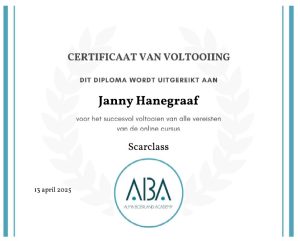
As you may know, I have been a fan of Alma Boerland for years – I call her the scar queen of the Netherlands. For me, she is my go-to expert when it comes to scar camouflage. I recently attended her online SCAR class: an intensive but incredibly valuable training course of about six hours, divided into ten modules and several practical cases. A training course in scar camouflage with permanent make-up reiterates how important it can be to camouflage scars.

It sometimes seems like an unnecessary luxury (learn to live with it), but for many, there is a story behind the scar. Sometimes a trauma that can be alleviated by making it less visible.
This online course gave me depth and breadth in the field of scar camouflage with permanent make-up. In professional terms, this is called dermatography or medical tattooing. I take you through some of the new insights I bring to my practice.
If you understand how a wound heals, you also know when and how a scar forms – and most importantly, how to improve it again.
By no means all scars are suitable for camouflage with permanent make-up – medical tattooing. You can read about that in colouring scars.
An important topic was also the different scar types.
We worked with the dry needling technique, which gives the scar a second chance to heal more beautifully, so to speak. At a later stage, pigment can be used. The choice of needles is crucial, as is the use of the body’s own blood serum – it is packed with growth factors and can speed up recovery enormously.
Scars are often more than just skin – they carry a story of pain, shame and strength.
Treatment is therefore not only about appearance, but also about self-image. Sometimes the goal is simply that someone dares to walk in short sleeves again next summer. And that is worth everything.